Blog · Food formulation
Carob in Sugar-Reduction Trials: What to Measure
If you remove two grams of sugar from a recipe and add carob, you have changed more than one variable. The carob brings sugars of its own, as well as flavour, colour and solids. A useful trial measures how those changes affect the food people actually eat.
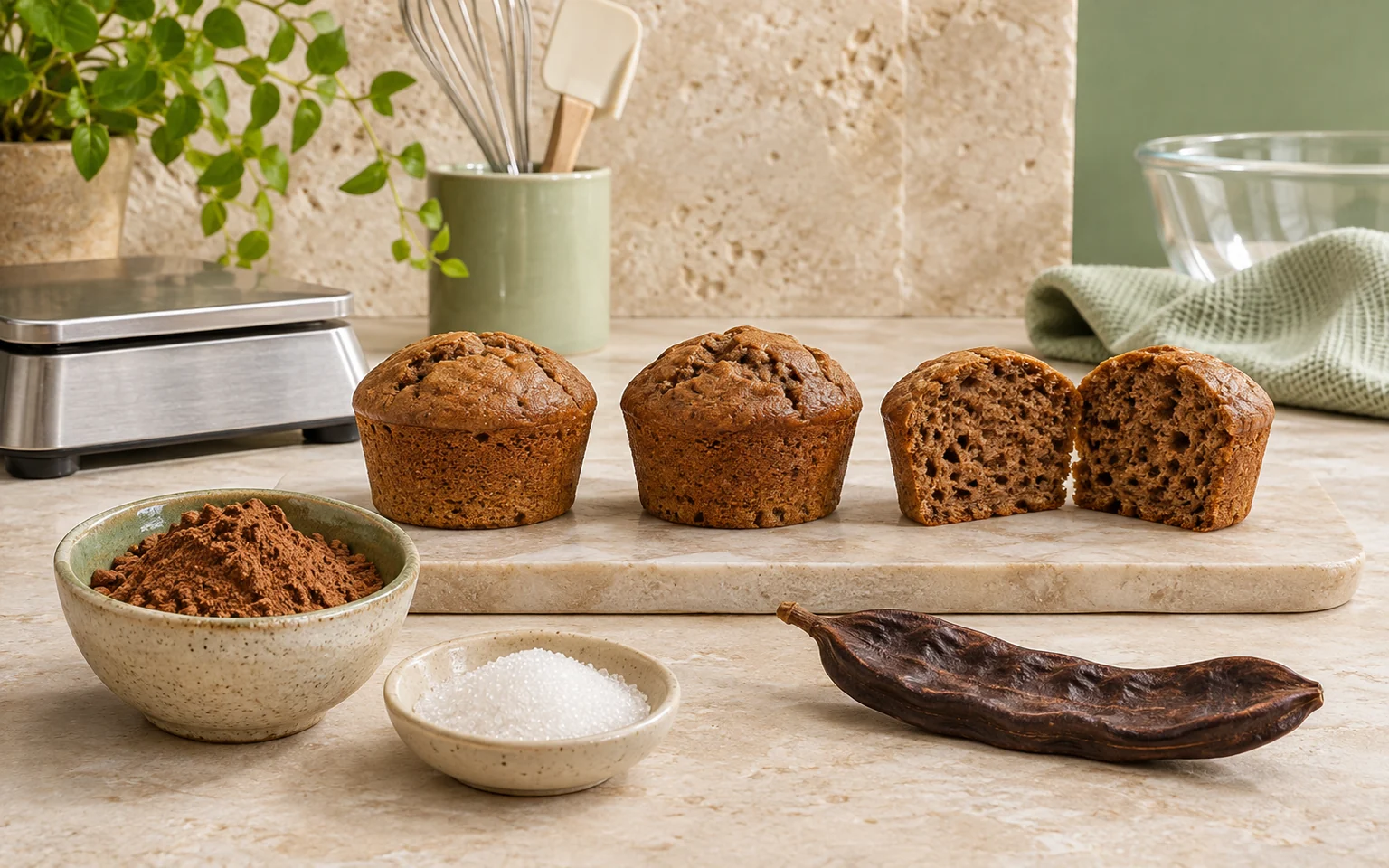
Separate the three questions
How much sugar did you add to the batch? How much total sugar is in the finished food? How sweet does it taste? Those answers can move in different directions. In a published muffin comparison, tasters perceived the carob version as sweeter and less bitter than its cocoa counterpart. That finding belongs to the study’s particular formula.
For the consumer side of this distinction, see our guide to reading carob labels.
| Target | Record |
|---|---|
| Sugar added to the recipe | Weighed sugar and quantities of any syrups, concentrates or other ingredients that contribute sugars. |
| Total sugars | Supplier composition for the actual lots, finished yield and a nutrition calculation or analysis appropriate to the product. |
| Perceived sweetness | Blind comparison at the same serving temperature and age, alongside bitterness and aftertaste. |
Run a reference and two trials
Keep the serving size, finished format and process comparable. Use the same carob grade and lot for both carob trials. Record every formula change, including what makes up the mass when you remove an ingredient.
A. Current recipe
Record ingredient weights, batch yield, processing settings and the current product’s texture and flavour.
B. Carob at the original sugar level
Use the chosen carob profile in the reformulated base while holding the weighed table sugar constant. Record ingredients displaced by the powder. This is the reference for the next trial.
C. Same carob, less added sugar
Keep the carob level the same as in B, reduce the weighed sugar and document how you rebalance mass. Compare B and C to see what changed after that adjustment.
Check yield as well as the recipe sheet
For a simplified batch calculation, imagine taking out 2 g of table sugar and introducing 4 g of a powder whose specification shows 45 g of sugars per 100 g. The powder contributes 1.8 g of sugars. If the other adjusted ingredients contribute no sugars, the batch has just 0.2 g less total sugar before processing. Those numbers are an illustration, not a Carob Orchards specification or a verified finished result.
Sugar also influences the structure of many foods. For a baked item, compare spread or rise, crumb, and texture at the start and during storage. Track finished weight and check moisture or water activity where relevant. Use verified product data and review the destination market’s rules before choosing a claim. EU nutrition claims rules.
Common questions
Does adding carob guarantee less sugar in the finished food?
No. Carob can change perceived sweetness, but it also contributes naturally occurring sugars. The finished result depends on the complete formula and its yield.
The three batches are a proposed comparison. The arithmetic example uses hypothetical inputs.
Carob Orchards · Valencia, Spain
Choose a sample for your own formulation
At Carob Orchards we supply Spanish carob powders in raw and roasted profiles. Share the product you are developing and your flavour, colour and texture targets. We can discuss a suitable sample and the current composition data for your trial.
Explore our carob powder for bakery and confectionery